|
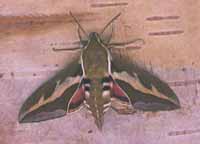
Manduca quinquemaculatus
RBCM, the Five-spotted Hawkmoth:
This large bodied moth flies in tobacco fields and vegetable gardens
(potatoes, tomatoes) and wherever host plants are found.
|
 |
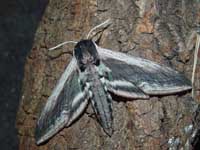
Sphinx chersis
RBCM, Northern Ash Sphinx; Great Ash Sphinx:
The upperside of the forewing is soft dark gray to blue-gray
with a series of black dashes, one of which reaches the wing tip.
|
Sphinx chersis, pre-pupal larva, July 27-28, 2006, Vancouver Island, Shannon Carifelle.
 |
Sphinx drupiferarum
RBCM,
the Wild Cherry Sphinx:
Forewings, long and slender, are held close to the body when the
moth is at rest. This moth is similar to Sphinx vashti.
|
 |
Sphinx perelegans
RBCM, Elegant Sphinx.
Sphinx perelegans adults fly in montane woodlands and mixed
chaparral-type vegetation as a single brood
in the north, with adults mainly on the wing in June and July.
It flies from dusk until after midnight. Note dark thorax.
|
 |
Sphinx vashti
RBCM, the Snowberry Sphinx:
Adults fly as a single brood in montane woodlands and along prairie
streamcourses from April to August.
The upperside of the forewing has a narrow black subterminal line
bordered by a white inverted V-shaped line on the outside, and a
black line at the apex. |
Sphinx vashti, Adams Lake, May 24, 2004, Kathy Francoeur.
 |
Pachysphinx modesta
RBCM,
the Modest Sphinx or Poplar Sphinx:
Hindwings are reddish purple with dark blue near anal angle.
They are a heavy bodied species.
|
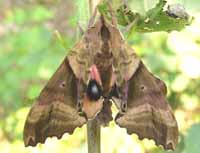 |
Paonias excaecata
RBCM/VG, Blinded Sphinx:
The outer margin of the forewing is quite wavy. There is a dark cell
spot and a dark oblique line mid wing from the costa almost to the
inner margin. Basic ground colour is pinkish brown. Flight would
be June-July. |
Paonias excaecata, Maple Ridge, July 3, 3014, Veanne Gilchrist
 |
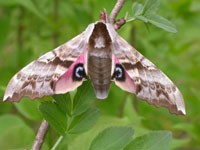
Paonias myops
RBCM,
the Small-eyed Sphinx
This species
ranges
across North America.
The hindwings have a small blue eyespot ringed with black on a
yellow background.
|
Paonias myops, Adams Lake, May 24, 2004, Kathy Francoeur.
 |
Smerinthus cerisyi
RBCM, the Cerisyi's
Sphinx or One-eyed Sphinx, Larvae feed on poplars and willows.
Flights would be from May-July as a single brood, although data suggests there might be two broods
in BC. and other areas along the west coast, as far south as california.
|
 | Larvae feed on poplars, aspen and willows.
Note different shape of double arced forewing pm line compared to the straighter pm line of cerisyi, directly above.
S. ophthalmica has smoother scalloping of the fw outer margin.
|
Smerinthus ophtlamica, Vernon, July 2005, courtesy of
Julie Pinette.
Smerinthus ophthalmica, Gabriola Island, July 2, 2007, courtesy of Jane Southern.
Smerinthus opthalmica, Maple Ridge, July 3, 3014, Veanne Gilchrist
Visit Smerinthus ophthalmica, Pemberton, May 15, 2010, courtesy of John Tschopp.
Smerinthus ophthalmica, Duncan, Vancouver Island, May 2, 2013, Sharon Jackson.
Visit Smerinthus ophthalmica, Canyon, June 13, 2013, Elaine Dixon.
 |
Smerinthus jamaicensis
RBCM, the
Twin-spotted Sphinx
Smerinthus jamaicensis closely resembles Smerinthus cerisyi, but
jamaicensis is much smaller with larger blue patches on more
vibrant and deeper purple in the lower wings.
|
See Hemaris comparison to help distinguish
the next two species.
 |
Hemaris thetis
RBCM, the Snowberry Clearwing or Bumblebee Moth,
The moth flies along forest edges and in meadows, gardens and
brushy fields. Day-flying adults nectar at lantana, dwarf bush honeysuckle,
snowberry, orange hawkweed, thistles, lilac, Canada violet, etc.
|
Hemaris thetis Gabriola Island, June 28, 2008
 |
Hemaris thysbe
RBCM, the Hummingbird Clearwing
It is not difficult to see why many gardeners would mistake an
Hemaris thysbe moth for a small hummingbird as it hovers, sipping nectar
from flowers through a long feeding tube. |
 | Introduced and established in southern B.C.
Larvae prefer Epilobium and Gallium, but will also eat foliage of other plants.
|
Deilephila elpenor, East Vancouver, June 16, 2011, Nayt Keane
Deilephila elpenor, Maple Ridge, July 27, 2011, Stephanie Larbalestier
Hyles gallii larva on Epilobium, Hazelton, Shannon Hurst.
 |
Hyles lineata
RBCM, the White-lined Sphinx
Adults usually fly at dusk, during the night, and at dawn, but they
also fly during the day over a wide variety of open habitats
including deserts, suburbs, and gardens.
|
Hyles lineata, August 25, 2005, near Radium Hot Springs, Cheryl Condy.
Hyles lineata September 2, 2012, Fort St. John, Elaine Walker.
 |
Adults fly in the afternoon from April-June in oak woodland and
pine-oak woodland in foothills, nectaring from chia, heartleaf
milkweed, golden currant, bluedicks, fairyfans, vetches,
thistles, hedgenettles, etc.
|
 | Proserpinus flavofasciata adults fly from
April-June in meadows in coniferous forests. Adults fly during the
afternoon, nectaring from lilac, dandelion, cherry, etc.
|
Proserpinus flavofasciata, Invermere, May 2006, Matthew Holden.
|