The Sphingidae of Indiana

Darapsa myron courtesy of John H. Campbell.
|
|
Updated as per James P. Tuttle's The Hawk Moths of North America, July 2008 |
Please help me improve this site by sending sighting data (species; location [county]; date) to Bill Oehlke. Images are also greatly appreciated and will be used and credited (with permission) on county pages. I will attempt to identify any Sphingidae larvae or adults that are unknown to you.
Sphinginae subfamily
|
Macroglossinae subfamily
Return to Index by NationReturn to U. S. A. Table Return to Main Sphingidae Index |
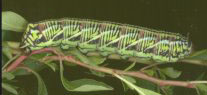
Scott writes, "I found four of them eating a rosette pond weed out in the middle of our lake (was cleaning out some of the weeds and saw them out there just above water level...) They started out kinda pink and after I brought them inside and put them on fuller pieces of plants...they turned green and got the lines and colors all over them....As a couple of them have dropped off and started their wandering around to burrow...they have turned back to these colors backed by a pale pink.....They are some of the biggest sphinx larvae that I have ever seen...including big poplar sphinx..Found a couple of days ago (September 26, 2004) here in Terre Haute, Indiana."
Individual county checklists (adult moths): Counties will be completed as sightings arrive. Currently only those in red are active.
Individual county checklists (adult moths): Counties will be completed as sightings arrive. Currently only those in red are active.

Eumorpha pandorus, Monroe County, Indiana, August 21, 2008, Katie and Monique
Individual county checklists (larvae): Counties will be completed as sightings arrive. Currently only those in red are active.
Individual county checklists (larvae): Counties will be completed as sightings arrive. Currently only those in red are active.
Southern Indiana
Eggs of many North American species are offered during the spring and summer. Occasionally summer Actias luna and summer Antheraea polyphemus cocoons are available. Shipping to US destinations is done from with in the US.
Use your browser "Back" button to return to the previous page.
This page is brought to you by Bill Oehlke and the WLSS. Pages are on space rented from Bizland. If you would like to become a "Patron of the Sphingidae Site", contact Bill.
Please send sightings/images to Bill. I will do my best to respond to requests for identification help.
 Show appreciation for this site by clicking on flashing butterfly to the left. The link will take you to a page with links to many insect sites. |
I very much appreciate all the many images that have been sent to me, or of which I have been granted permission to copy and post from other websites. All images on this site remain the property of respective photographers.
If you would like to contribute to the maintenance of this website by sending a contribution to
Bill Oehlke
Box 476
155 Peardon Road
Montague, Prince Edward Island, C0A1R0
Canada
your donation would be much appreciated and would be used for
1) paying for webspace rental;
2) paying for computer maintenance and software upgrades;
3) purchases of additional text reference material (journals and books) in anticipation of expanding the site to a worldwide Sphingidae site;
4) helping to pay my daughter's tuition (completed spring 2013); with anything left over going to humanitarian aid.
If you are mailing a check from USA, please use $1.10 postage (2013 rate; $1.25 2018 rate). Donations can also be made through Paypal via the button below.