Sphingidae of Panama

I have added (August 28, 2007) Isognathus leachi based on the following image.

Isognathus leachi, Mogue, Darien, Panama, August 25, 2007,
courtesy
of Dr. Arthur Anker, STRI.
Linette Mansberger provides the following image from Panama and asked for id cofirmation. My (Bill Oehlke) comments are below the photo.

Adhemarius species??, Bocas del Toro, Bastimentos Island, Panama,
September, 2012, courtesy of Linette Mansberger

Eumorpha capronnieri, Cerro Chucanti, Darien, Panama,
August 22-24, 2012, courtesy of Albert Thurman.
Many thanks to Tony James who has recently (May 2015) sent me quite a few images with data from Panama: Panama: Gamboa and Radisson.
List of Sphingidae from Panama
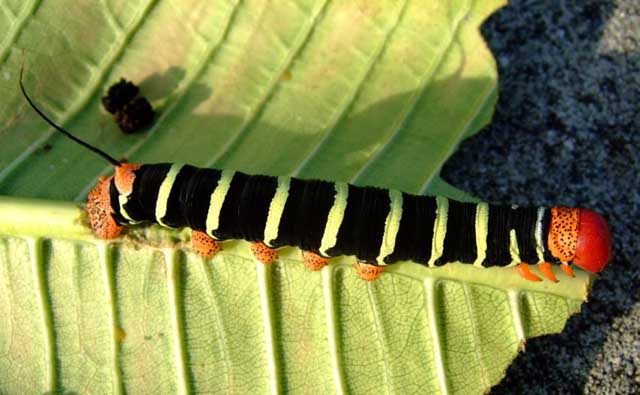
Pseudosphinx tetrio, Canal Zone, Panama, courtesy of Russell Bean.
Russell made some interesting observations and writes, "Hi, I found your web page when trying to find which caterpillar was eating a tree on the canal causeway in Panama, I have attached a few photos if you wanted to see them or use them, feel free. The caterpillars are all over the tree. I don’t think it will last long.
"The two things I still don’t know after looking at your web site are 1. Why don’t the birds eat and attack them. I have seen them dead on the floor and the birds still don’t eat them, are they poisonous? 2. Also what does the spike on the back do, is it a sting or just a distraction tactic so there heads don’t get attacked?"
I wrote back, "Thanks for sending pictures. The trees produce a toxic substance which does not harm the caterpillars but is absorbed into their tissues when they feed upon it. The caterpillar then becomes toxic or at least distasteful to birds and other would-be-predators.
The spike at the end is typical of many caterpillars of the Sphingidae family. The spike or anal horn is harmless and might be either a distraction or a perceived threat as you have indicated. There are some caterpillars from other families that have poisonous spines, but not this one.
Generally caterpillars with black, yellow, red colouration carry toxins."
Large numbers of caterpillars can defoliate an entire tree or bush. This usually does not fatally harm the plant provided the defoliation does not happen repeatedly (two or more years in succession).

Pachylia ficus, Canopy Tower, Soberania National Park, Panama, courtesy Jim Swalwell.

Manduca rustica, Gamboa, Panama, November 19th 2006, courtesy Jim Swalwell.

Xylophanes pluto, Canopy Lodge, El Valle de Anton, Panama,
November 2011, courtesy of Elliotte Rusty Harold.
Go to Indices of Nations
Go to South American Index
Go to Central American Index
This page is brought to you by Bill Oehlke and the WLSS. Pages are on space rented from Bizland. If you would like to become a "Patron of the Sphingidae Site", contact Bill.
Please send sightings/images to Bill. I will do my best to respond to requests for identification help.
This website has been created and is maintained by Bill Oehlke without government or institutional financial assistance. All expenses, ie., text reference support material, webspace rental from Bizland, computer repairs/replacements, backups systems, software for image adjustments (Adobe Photoshop; L-View), ftp software, anti-virus protection, scanner, etc. are my own.
I very much appreciate all the many images that have been sent to me, or of which I have been granted permission to copy and post from other websites. All images on this site remain the property of respective photographers.
If you would like to contribute to the maintenace of this website by sending a contribution to
Bill Oehlke
Box 476
155 Peardon Road
Montague, Prince Edward Island, C0A1R0
Canada
your donation would be much appreciated and would be used for
1) paying for webspace rental;
2) paying for computer maintenance and software upgrades;
3) purchases of additional text reference material (journals and books) in anticipation of expanding the site to a worldwide Sphingidae site;
4) helping to pay my daughter's tuition (completed spring 2013); with anything left over going to humanitarian aid.
If you are mailing a check from USA, please use $1.10 postage (2013 rate); $1.15 (2014 rate). Donations can also be made through Paypal via the button below.