Gila County, Arizona

Sphingidae
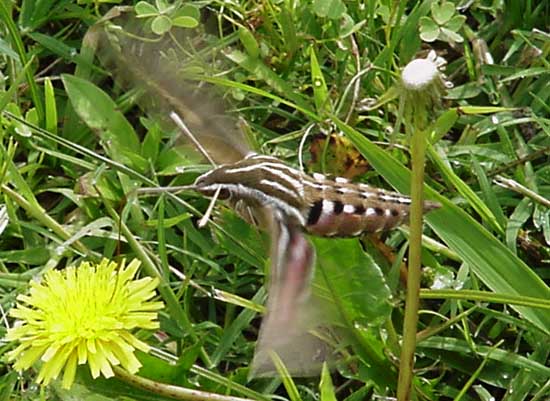
Hyles lineata, common in Gila County, Arizona

This site has been created by Bill Oehlke at oehlkew@islandtelecom.com
Comments, suggestions and/or additional information/sightings are welcomed by Bill.

This page is inspired by and dedicated to Evan Rand of Phoenix, Arizona (Maricopa County).

Evan writes, "I do frequent light-trapping in the summer. I do set up traps frequently in neighboring Gila County and in Maricopa County. I have personally collected two Eumorpha typhon specimens (both perfect) in Gila County."

Evan sent the following summary for Gila and nearby counties:

"Paonias myops - Edge of Maricopa Co./Gila Co. 8/05 (rare only seen 1)
Pachysphinx occidentalis - Uncommon Both Maricopa Co. and Gila Co. From April to August
Eumorpha achemon - Maricopa Co. (rare only 1 in April)
Eumorpha typhon - Gila Co. (rare only 2, late July, early August)
Manduca sexta - Uncommon in Maricopa Co. (Mostly seen in late September, early October) Uncommon in Gila Co. (Late July/August), Common in Santa Cruz Co. (Late July/August)
Manduca rustica - Rare in Maricopa Co. (late September), uncommon in Santa Cruz Co.
Manduca muscosa - uncommon in Santa Cruz Co. (late July)
Agrius cingulata- Rare in Maricopa Co. (late September)
Smerinthus cerisyi - Uncommon in Maricopa and Gila Co. (late July/early August)
Sphinx dollii - Common in Gila Co. (late July/early August)
Sphinx chersis - Uncommon in Gila Co. (late July/early August)
Xylophanes falco - Uncommon in Santa Cruz Co. (late July/early August)
Hyles lineata - Very common Maricopa, Yavapai, Gila, Pima, Santa Cruz Cos. (March to October). This species is extremely common almost everywhere, I've seen hundreds of individuals at a single light before, and thousands of larva crawling across the desert. It's hard to light trap anywhere between March and October and not get at least one H. lineata."

Fifty-three Sphingidae species are listed for Arizona on the U.S.G.S. website. Not all of the species are reported or anticipated in Gila County (sixteen are reported on U.S.G.S.). It is hoped that this checklist, with the thumbnails and notes, will help you quickly identify the moths you are likely to encounter.

A "WO" after the species name indicates that I (William Oehlke) expect that this moth is present or might be present, although unreported. A "USGS" indicates the moth is confirmed on USGS site.

Please help me develop this list with improved, documented accuracy by sending sightings (species, date, location), preferably with an electronic image, via email to Bill Oehlke.

Sphinginae subfamily

Sphingini tribe:

Agrius cingulata, WO, Pink-spotted Hawkmoth

This moth is a very strong flier, and make its way to southern Arizona and southern California.

It is not confirmed for Gila County, but might occur as a rare stray.

Manduca florestan ER

The upperside of the forewing is gray to yellowish gray to brown. The reddish brown patch just outside the cell and above the dashes is the most distinguishing character.

Manduca quinquemaculata USGS/ER, the Five-spotted Hawkmoth

This species is confirmed in Gila County, and has been seen in nearby counties. I suspect if you grow tomatoes, you might encounter it.

Manduca rustica WO, the Rustic Sphinx

This species is not officially recorded in Gila County, but it has been taken in other nearby counties. Look for three large yellow spots on each side of the abdomen. rare, if present

Manduca sexta ER, the Carolina Sphinx

This species has been recorded in Gila County by Evan Rand. If you grow tomatoes, you may have encountered it.

Larvae get very large and can strip a tomato plant.

Sphinx asella USGS, the Asella sphinx

The upperside of the forewing is pale silver-gray with a series of black dashes, a white patch at the tip, and a white stripe along the outer margin. The upperside of the hindwing is black with blurry white bands.

Sphinx chersis USGS/ER, the Northern Ash Sphinx or Great Ash Sphinx

This species is reported in Pima. Larval hosts are ash, lilac, privet, cherry, and quaking aspen.

Sphinx dollii USGS/ER--common, the Doll's sphinx

Sphinx dollii (Wing span: 1 3/4 - 2 1/2 inches (4.5 - 6.3 cm)), flies in arid brushlands and desert foothills from Nevada and southern California east through Utah, Arizona, Colorado, and New Mexico to Oklahoma and Texas.

Smerinthini Tribe:

Pachysphinx occidentalis USGS/ER--uncommon, the Big Poplar Sphinx

This one is quite similar to Pachysphinx modesta, with modesta being smaller and darker.

Moths should be on the wing from June-August.

Paonias excaecata USGS, the Blinded Sphinx,

The outer margin of the forewing is quite wavy. There is a dark cell spot and a dark oblique line mid wing from the costa almost to the inner margin. Basic ground colour is pinkish brown.

Flight would be June-July. probably rare

Paonias myops USGS/ER--rare, the Small-eyed Sphinx

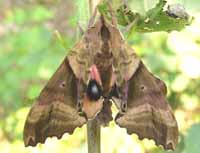
Named for the small eye-spot in the hindwing, this moth has a wide distribution but is probably quite rare in Gila County.

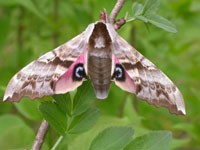
Smerinthus cerisyi USGS/ER--uncommon, the Cerisyi's Sphinx or One-eyed Sphinx,

Larvae feed on poplars and willows.

Flight would be from late May-July-early August as a single brood.

Macroglossinae subfamily


Dilophonotini tribe:

Erinnyis crameri, the Cramer's Sphinx, USGS

The upperside of the abdomen is gray, without black bands, and the underside does not have black spots. The upperside of the forewing is dark brown, and may have pale yellow-brown patches along the inner edge. rare stray

Erinnyis ello USGS, the Ello Sphinx

This species is reported in Gila County and in other southern Arizona counties.
Males and females differ.rare stray

Erinnyis obscura, the Obscure Sphinx, USGS

During the night adults nectar at flowers, including bouncing bet (Saponaria officinalis) and Asystasia gangetica beginning at dusk.

July and August are flight times in the southern states. rare stray

Hemaris diffinis USGS, the Snowberry Clearwing or Bumblebee Moth

This moth is widespread and has been officially recorded in Gila County.

Philampelini tribe:

Eumorpha achemon USGS, the Achemon Sphinx

This moth is officially reported for Gila County.
Eumorpha achemon larvae feed upon Grape (Vitis), Virginia Creeper (Parthenocissus quinquefolia) and other vines and ivies (Ampelopsis). probably rare

Eumorpha labruscae USGS, the Gaudy Sphinx

The Gaudy Sphinx flies in America, and although primarily a tropical species, it has been taken as far north as Saskatchewan as a stray. Forewings are a vibrant grey-green. rare stray

Eumorpha typhon USGS/ER, the Typhon Sphinx

The upperside of wings is deep red-brown with pale brown bands. Each hindwing has pink along the costal margin and a triangular white spot on the outer part of the inner margin. confirmed by Evan Rand

Macroglossini tribe:

Hyles lineata USGS/ER-very common, the White-lined Sphinx

Larvae can be quite varied.


Evan Rand writes, "Hyles lineata is very common and widespread throughout the state. For example, I had about six come to my lights in March in Gardner Canyon (Pima Co.) in only an hour of lighting. I had several dozen come to MV lights by Pena Blanca Lake (Santa Cruz Co.) last year. A few years ago I saw thousands of larva crossing the desert west of Tucson in August (Pima Co.). I've seen hundreds of adults come to large lights in Scottsdale (Maricopa Co.) in late March/early April. In Sycamore Creek (extreme NE Maricopa Co.) in August of 2005 I saw hundreds flying just before dark. I usually encounter them in moderate numbers (maybe 5-6 per night) in Gila Co. in late July and early August coming to gas station lights in Payson, Star Valley, Pine and Kohl's Ranch. I've seen them in numbers during the afternoon taking nectar from petunias just north of Page in S. Utah in late May. To summarize, it's by far the most common sphingid in the state, and I bet it's found in every county (although I can't confirm that)."

On August 8, 2007, Evan writes, "I just started with central Arizona where Hyles lineata is having an excellent year. There are about 10 times more than average. I've also gotten Manduca sexta, Sphinx dollii, Pachysphinx occidentalis, and Smerinthus ceryisi (which is pretty typical) to come to lights. Also, there have been a few Sphingicampa hubbardi. However the find so far has been a Gila county record Manduca florestan (perfect specimen as well)."

Use your browser "Back" button to return to the previous page.

This page is brought to you by Bill Oehlke and the WLSS. Pages are on space rented from Bizland. If you would like to become a "Patron of the Sphingidae Site", contact Bill.

Please send sightings/images to Bill. I will do my best to respond to requests for identification help.