|
|
Created/dedicated as per personal communication with Melissa Rogers and Rogers family (Hyles lineata, Eumorpha achemon, Mesa), September, 2008
Updated as per James P. Tuttle's The Hawk Moths of North America, January 13, 2009
Updated as per personal communication with T. J. Robb (Manduca rustica, Chandler), October, 2009
Updated as per personal communication with Cynthia Kraft (Manduca sexta, Phoenix), October 19, 2011
Updated as per BAMONA, October 19, 2011
Updated as per personal communication with Christopher Seay regarding larva found by students of Vista Del Sur Traditional School, Laveen, Arizona; May 10, 2012
|
Maricopa County, Arizona
Sphingidae Larvae

Hyles lineata, fifth instar, Mesa, Maricopa Co., Arizona,
September 18, 2008, courtesy of Melissa Rogers and the Rogers family.
This site has been created by
Bill Oehlke at oehlkew@islandtelecom.com
Comments, suggestions and/or additional information/sightings are welcomed by Bill.
For care of "found larvae/caterpillars" visit Manduca sexta larva, central Texas, August 21, 2008, Trina Woodall.
This page is inspired by and dedicated to
the Rogers family: Dace, Melissa, Benjamin, Breanna and Joshua. Melissa sent me the beautiful
images of the Hyles lineata larva at the top of the page and of the
Eumorpha achemon larva at the bottom of the page.
Melissa writes, "We were pulling some weeds in our back yard here in Mesa, Arizona, and came accross these two caterpillars. Could you identify them for us.
They were muching on some weeds that had gotton out out of control."
I replied, "Melissa,
"The Sphinx larva with the anal horn is Hyles lineata, the White-lined Sphinx. It is a highly variable caterpillar of a species very common in Maricopa County.
The hornless larva is that of Eumorpha achemon, the Achemon Sphinx."
The family was successful in getting the Hyles lineata larva to pupate. The adult moth depicted below emerged on November 15, 2008.

Hyles lineata, adult, Mesa, Maricopa Co., Arizona,
November 15, 2008, courtesy of Melissa Rogers and the Rogers family.

Hyles lineata, adult, Mesa, Maricopa Co., Arizona,
November 15, 2008, courtesy of Melissa Rogers and the Rogers family.
"What are you looking at!"
Thanks also to T.J. Robb who confirms Manduca rustica from Chandler. Images are posted
via the link in the Manduca rustica sighting report.
Many thanks to Christopher Seay, Computer Associate / Technology Liaison, who sends the following image of a mature Sphinx chersis larva found by students
of Vista Del Sur Traditional School in Laveen, Maricopa County, Arizona.

Sphinx chersis mature larva, Laveen, Maricopa County, Arizona, May 8, 2012,
courtesy of Christopher Seay and students
of Vista Del Sur Traditional School.
For care of "found larvae/caterpillars" visit Manduca sexta larva, central Texas, August 21, 2008, Trina Woodall.
Fifty-nine Sphingidae species are listed for Arizona on the BAMONA
website. Not all of the species are reported or anticipated in
Maricopa County (seventeen are reported on BAMONA as of October 19, 2011). It is hoped
that this checklist, with the thumbnails and notes, will help you
quickly identify the caterpillars you are likely to encounter.
A "WO" after the species name indicates that
I (William Oehlke) expect that this moth is present or
might be present, although unreported.
A "BAMONA" indicates the species is confirmed
on BAMONA site.
Please help me develop this list with improved, documented accuracy
by sending sightings (species, date, location), preferably with an
electronic image, via email to
Bill Oehlke.
Please also forward your sightings to BAMONA, an excellent online resource.
Two of the species listed by BAMONA probably only occur as adult strays so you would not likely encounter their larvae, and they are
not included below: Pachylia ficus (Fig sphinx); Xylophanes falco (Falcon sphinx).
Sphinginae subfamily
Sphingini tribe:
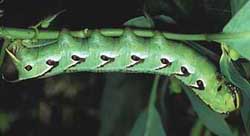 |
Agrius cingulata,
BAMONA Pink-spotted Hawkmoth:
Larvae feed on plants in the Convolvulaceae family, especially
Ipomoea batatas (sweet potato) and in the Solanaceae family,
especially (Datura) (jimsonweed) and related plants in the
Americas. There is also a brown form. Look for very large, dark
spiracular circles. likely as an adult stray; unlikely in larval stage
|
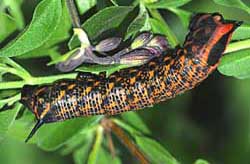 | Salvia greggii has been confirmed as a larval host
by Robert A. Behrstock.
Jim Tuttle, tentative id, writes, "All of the
penultimate instars of both Lintneria (Sphinx) istar and
Lintneria (Sphinx) separatus that I have reared
have been mundane green."
|
|
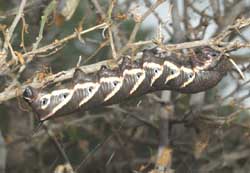
The caterpillars are called Tomato Hornworms and each has a black horn at the end of the abdomen.
Larvae feed on potato, tobacco, tomato, and other plants in the
nightshade family (Solanaceae). Most larvae are green, but there is also a very beautiful brown
form to the left.
|
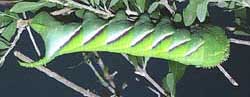 |
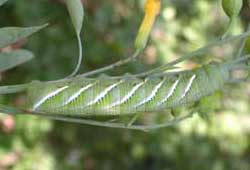
Manduca rustica
BAMONA/TJR, the Rustic Sphinx
The caterpillar has numerous white nodules on top of the thorax and
seven pairs of oblique, blue-gray stripes along the side of the body.
The horn is white at the base and blue-gray at the tip. Many hosts
are utilized.
|
Manduca rustica fifth instar, Chandler, October 8, 2009, courtesy of T. J. Robb.
 |
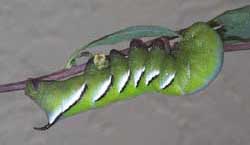
Manduca sexta
BAMONA/CK,
the Carolina Sphinx
Tobacco Hornworms, equipped with a red-tipped horn at the end of the
abdomen, are true gluttons and feed on tobacco and tomato, and
occasionally potato and pepper crops and other plants in the
nightshade family (Solanaceae).
|
Manduca sexta fifth innstars, Phoenix, October 19, 2011, Cynthia Kraft
 |
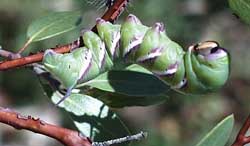
Larval hosts are unknown, but larvae probably feed on Lycium
in the nightshade family (Solanaceae).
Note the strong oblique black lines and the black anal horn.
|
 |
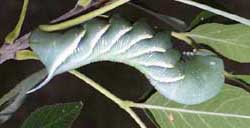
Larval hosts are Manzanita and Arctostaphylos
of the Ericaceae family. Look for a blue horn and strong purple
colouration.
|
 |
Sphinx chersis
BAMONA,
the Great Ash Sphinx
The larvae are pale bluish green. The head has a pair of yellow
lateral bands meeting at the apex.
Larval hosts are ash, lilac, privet, cherry, and quaking aspen.
|
Sphinx chersis mature larva, Laveen, May 8, 2012, Christopher Seay and students
of Vista Del Sur Traditional School.
Smerinthini Tribe:
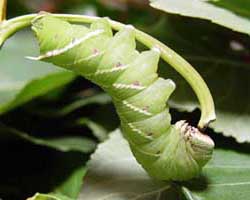 |
Larvae feed on cottonwood and poplar (Populus) and willow
(Salix).
Larvae are very chunky with little to distinguish them
from Pachysphinx modesta.
|
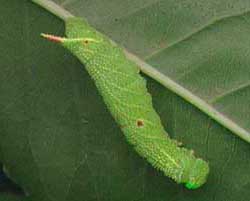 |
Paonias myops
WO?,
the Small-eyed Sphinx
Wild cherry species are the favorites as larval
foodplants, but eggs will also be deposited on birches and other
forest trees. To the left a second/third instar larva rests on pin
cherry.
The "red heart" marking readily identifies this species.
generally more eastern species; possibly |
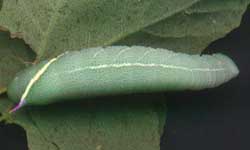 |
Smerinthus cerisyi
BAMONA,
Cerisy's Sphinx;
Cerisyi larvae greatly resemble modesta larvae, both being pale
green, with granular skin, pale lateral diagonal lines, faint red
spiracular circles, and very pale longitudinal lines running from the
head to a more pronounced anal diagonal line.
Larvae have green heads bounded dorsally with a pale yellow
inverted "V".
|
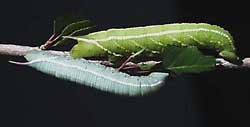 |
Smerinthus saliceti
BAMONA, the Salicet
Sphinx, flies in valleys and along streamsides from Mexico City north
to west Texas, southern Arizona, and extreme southern California.
There are two colour morphs, one a pale green and one lime green.
Larvae feed on willow (Salix) or poplar (Populus).
|
Macroglossinae subfamily
Dilophonotini tribe:
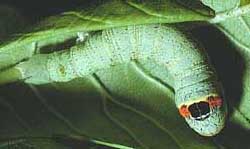 |
Larvae feed on various plants in the dogbane family
(Apocynaceae): Rauvolfia ligustrina, Rauvolfia tetraphylla,
Stemmadenia obovata. There is also a brown form.
likely as an adult stray; unlikely in larval stage.
|
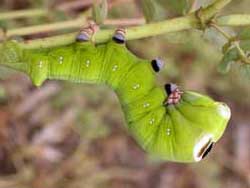 |
Larvae feed on papaya (Carica papaya), Cnidoscolus
angustidens, poinsettia (Euphorbia pulcherrima),
guava (Psidium species) and
saffron plum (Bumelia angustifolia/Bumelia celastrina).
Manilkara bahamensis,
Willow Bustic (Bumelia salicifolia)
and Painted Leaf (Poinsettia heterophylla) are also hosts.
Nice socks! Larvae show considerable variation.
|
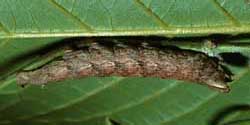 |
Erinnyis obscura, the Obscure Sphinx,
BAMONA
Larvae feed on Rauvolfia ligustrina, Rauvolfia tetraphylla,
Stemmadenia obovata, Philibertia, Cynanchum, papaya
(Carica papaya), Asclepiadaceae, Blepharodon mucronatum,
White vine (Sarcostemma clausum) and Morrenia odorata.
|
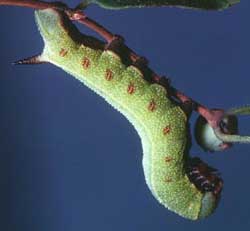 |
Larval host plants include Snowberry (Symphoricarpos),
honeysuckle (Lonicera), Coralberry, viburnums, high bush cranberry and hawthorn (Crataegus).
Horn is black with a slightly lighter base. This western species was formerly classified as
H. diffinis or H. senta. Those species west of the Continental Divide are now classified as
H. thetis.
|
Philampelini tribe:
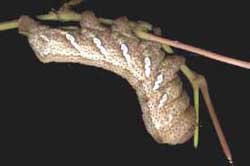 |
Larvae feed upon Grape (Vitis), Virginia Creeper
(Parthenocissus quinquefolia) and other vines and ivies
(Ampelopsis).
Larvae occur in both a light (green) form and a darker (tan/brown)
form. Note six "segmented" oblique lines.
|
Eumorpha achemon, Melissa Rogers (Rogers family), Mesa, September 18, 2008
Macroglossini tribe:
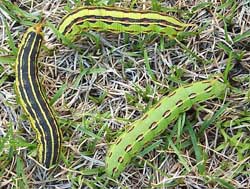 |
Hyles lineata
BAMONA/MR, the White-lined Sphinx
Larvae are highly varied and feed on a great diversity of plants
including willow weed (Epilobium), four o'clock (Mirabilis),
apple (Malus), evening primrose (Oenothera), elm
(Ulmus), grape (Vitis), tomato (Lycopersicon),
purslane (Portulaca), and Fuschia.
All larvae seem, however, to have the red/black swellings split by
dorso-lateral lines. |
Hyles lineata, Melissa Rogers (Rogers family), Mesa, September 18, 2008
|
|

Eumorpha achemon, fifth instar, Mesa, Maricopa Co., Arizona,
September 18, 2008, courtesy of Melissa Rogers and the Rogers family.
Enjoy some of nature's wonderments, giant silk moth cocoons.
These cocoons are for sale winter and fall. Beautiful Saturniidae moths will emerge the following spring and summer.
Read Actias luna rearing article.
Additional online help available.
Eggs of many North American species are offered during the spring and summer. Occasionally
summer Actias luna and summer Antheraea polyphemus cocoons are available. Shipping to US destinations is done
from with in the US.
Use your browser "Back" button to return to the previous page.
This page is brought to you by
Bill Oehlke and the
WLSS. Pages are on space rented from Bizland. If you would like
to become a "Patron of the Sphingidae Site", contact Bill.
Please send sightings/images to Bill. I will do my best to respond to
requests for identification help.
 | 
Show appreciation for this site by clicking on flashing butterfly to the left.
The link will take you to a page with links to many insect sites. |