Sphinginae subfamily
Sphingini tribe:
 | This species is a strong migrant and adults nectar from
deep-throated flowers including moonflower (Calonyction aculeatum),
morning glory (Convolvulus), honey suckle (Lonicera)
and petunia (Petunia species).
|
Agrius cingulata - 3 specimens, Jct. of FR 49 and FR 812, Patagonia Mountains, 7 Aug. 2010, elevation 5100', Evan rand
 |
The fringes of the upper wings are checkered black and white. The
upperside of the forewing is dark gray with black
bars and dashes and whitish patches. The upperside of the hindwing is
dark brown with pale gray at the base and has
two black transverse lines.
|
Ceratomia sonorensis
Evan Rand, August 8, 2007, Pena Blanca
 | This small moth flies at dusk. Both the forewing and the hindwing have a dark spot at the anal angle.
The forewing has a dark cell marking with a white center. There is also a dark patch along the inner margin in the basal area.
|
Dolbogene hartwegii, Robert J. Nuelle, III, August 7, 2004
Dolbogene hartwegii - 1 male, California Gulch, Atascosa Mountains, 21 July 2010, elevation 3800', Evan Rand
 | The upperside of the forewing is dark gray with brown tinges. A
series of narrow dashes runs from the tip to the
cell spots, and a wide black band runs from the middle of the
outer margin to the base of the wing.
|
Sphinx istar
Ira Nadborne, July 13, 2004, Madera
Evan Rand, July 30-31, 2008, Jct. FR 49 and FR 912, near Harshaw
Linternia istar - 1 specimen, Harshaw Townsite, Patagonia Mountains, 6 Aug. 2010, elevation 4850', Evan Rand
 | The upperside of the forewing is dark gray with black and light gray
wavy lines. The upperside of the hindwing is black with a brownish
gray border and two white bands.
|
Linternia separatus - 1 specimen, Jct. of FR 49 and FR 812, Patagonia Mountains, 7 Aug. 2010, elevation 5100', Evan Rand
 | The upperside of the forewing is dark gray with black and light gray
wavy lines. The upperside of the hindwing is black with a brownish
gray border and two white bands.
|
 |
The upperside of the forewing is gray to yellowish gray to brown.
The reddish brown patch
just outside the cell and above the dashes is the most distinguishing
character.
|
Manduca florestan
Robert J. Nuelle, Jr., August 6, 2004, Pena Blanca
Evan Rand, August 8, 2007, Pena Blanca;
Evan Rand, (many), July 26-27, 2008, Pena Blanca Canyon
Evan Rand, July 30-31, 2008, Jct. FR 49 and FR 912, near Harshaw
Ira Nadborne, (8), July 13, 2007, Coronado National Forest, Madera Canyon Upper Parking lot,
Santa Rita Mts, 6000Ft
 |
The upperside of the moth is soft greenish gray; the forewing has a
small green to white cell spot, and the hindwing has black bands
and a black patch at the base.
|
Manduca muscosa
Evan Rand, (late July); August 8, 2007, Pena Blanca
Evan Rand, (10-20), July 26-27, 2008, Pena Blanca Canyon
Evan Rand, July 30-31, 2008, Jct. FR 49 and FR 912, near Harshaw
 | Manduca occulta can be differentiated from M. sexta
which has 2/3 black, 1/3 white checkering on the
forewing, while occulta has equal amounts of black and white
checkering.
|
Manduca occulta, Evan Rand, July 30-31, 2008, Jct. FR 49 and FR 912, near Harshaw
Manduca occulta - 2 males, Harshaw Townsite, Patagonia Mountains, 2 Aug. 2010, elevation 4850', Evan Rand
Manduca occulta - 1 male, California Gulch, Atascosa Mountains, 21 - July 2010, elevation 3800', Evan Rand
 |
This species is confirmed in Yavapai County, and
has been seen in nearby counties.
I suspect if you grow tomatoes, you are likely to encounter it.
|
Manduca quinquemaculata
Evan Rand, (many), July 26-27, 2008, Pena Blanca Canyon
Evan Rand, July 30-31, 2008, Jct. FR 49 and FR 912, near Harshaw
 |
Manduca rustica
USGS/RJN/ER, the Rustic Sphinx
This species is officially recorded in Yavapai County, and it has been
taken in other nearby counties. Look for three large yellow spots
on each side of the abdomen.
|
Manduca rustica
Robert J. Nuelle, Jr., August 6, 2004, Pena Blanca;
August 7, 2004, California Gulch
Evan Rand, uncommon; Evan Rand, August 8, 2007, Pena Blanca
Evan Rand, (6) July 26-27, 2008, Pena Blanca Canyon
Evan Rand, July 30-31, 2008, Jct. FR 49 and FR 912, near Harshaw
 |
Manduca sexta
USGS/ER/IN, the Carolina Sphinx
This species is recorded in Yavapai County.
If you grow tomatoes, you have probably encountered it, though.
Larvae get very large and can strip a tomato plant.
|
Manduca sexta
Evan Rand, Common in Santa Cruz Co. (Late July/August)
Evan Rand, August 8, 2007, Pena Blanca
Evan Rand, July 26-27, 2008 (many), Pena Blanca Canyon
Evan Rand, July 30-31, Jct. FR 49 and FR 912, near Harshaw
Ira Nadborne, (15), July 13, 2007, Coronado National Forest, Madera Canyon Upper Parking lot,
Santa Rita Mts, 6000Ft
 |
Sagenosoma elsa
WO, the Elsa sphinx:
Forewing upperside has a wide white band along the costa from base to apex. The remainder of the wing has black and white bands.
The entire forewing is speckled with dark dots and has a light dusting of pale yellow to yellow-green scales.
The upperside of the hindwing is white with two black bands.
|
 |
The upperside of the forewing is pale silver-gray with a series of
black dashes, a white patch at the tip, and a white stripe along the
outer margin. The upperside of the hindwing is black with blurry
white bands.
|
Sphinx asellus
Evan Rand, (5-6), July 26-27, 2008, Pena Blanca Canyon
 |
Sphinx chersis
USGS/RJN/ER,
the Northern Ash Sphinx or Great Ash Sphinx
This species is reported in Yavapai. Larval hosts are ash,
lilac, privet, cherry, and quaking aspen.
|
Sphinx chersis
Robert J. Nuelle, Jr., August 6, 2004, Pena Blanca
Evan Rand, July 30-31, 2008, Jct. FR 49 and FR 912, near Harshaw
 |
Sphinx dollii
USGS/RJN/IN/ER,
the Doll's sphinx
Sphinx dollii (Wing span: 1 3/4 - 2 1/2 inches (4.5 - 6.3 cm)),
flies in arid brushlands and desert foothills from Nevada and
southern California east through Utah,
Arizona, Colorado, and New Mexico to Oklahoma and Texas.
|
Sphinx dollii
Robert J. Nuelle, Jr., August 6, 2004, Pena Blanca
Ira Nadborne, (12) July 13, 2007, Coronado National Forest, Madera Canyon Upper Parking lot,
Santa Rita Mts, 6000Ft
Evan Rand, July 30-31, 2008, Jct. FR 49 and FR 912, near Harshaw
 | The upperside of the forewing is pale blue-gray to dark gray with a black dash reaching the wing tip and
a white stripe along the lower outer margin.
The upperside of the hindwing is black with two diffuse white
bands, the upper one being practically non-existent.
|
Evan Rand, (3), July 26-27, 2008, Pena Blanca Canyon
July 18, 2009, California Gulch, Santa Cruz Co. - several males); Evan Rand
July 17, 2009, Pena Blanca Canyon, Santa Cruz Co. - several males); Evan Rand
| The upperside of the forewing is dark gray with black and light gray
wavy lines. The upperside of the hindwing is black with a brownish
gray border and two white bands.
|
Smerinthini Tribe:
 |
This one is quite similar to Pachysphinx modesta, with modesta
being smaller and darker.
Moths should be on the wing from June-August.
|
Pachysphinx occidentalis
Robert J. Nuelle, Jr., August 6, 2004, Pena Blanca;
Evan Rand, August 8, 2007, Pena Blanca
Evan Rand, (6), July 26-27, 2008, Pena Blanca Canyon
Evan Rand, July 30-31, 2008, Jct. FR 49 and FR 912, near Harshaw
Ira Nadborne, (4), July 13, 2007,
Coronado National Forest, Madera Canyon Upper Parking lot,
Santa Rita Mts, 6000Ft
 |
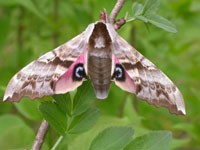
Paonias myops
USGS/IN/ER, the Small-eyed Sphinx
Named for the small eye-spot in the hindwing, this moth has a wide
distribution.
|
Paonias myops
Ira Nadborne, (2), July 13, 2004, Madera
Evan Rand (2), July 26-27, 2008, Pena Blanca Canyon
 |
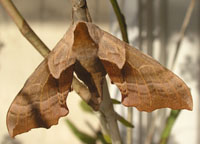
Smerinthus cerisyi
USGS/ER, the Cerisyi's
Sphinx or One-eyed Sphinx, Larvae feed on poplars and willows.
Flight would be from late May-July as a single brood.
|
Smerinthus cerisyi
Evan Rand, August 8, 2007, Pena Blanca; (1), July 26-27, 2008, Pena Blanca Canyon
Evan Rand, July 30-31, 2008, Jct. FR 49 and FR 912, near Harshaw
 |
Smerinthus saliceti
USGS/ER/IN, the Salicet
Sphinx, flies in valleys and along streamsides from Mexico City north
to west Texas, southern Arizona, and extreme southern California.
Larvae feed on poplars and willows.
Flight would be from late April-September, probably as a double brood.
|
Smerinthus saliceti
Evan Rand, August 8, 2007, Pena Blanca
Ira Nadborne, (6), July 13, 2007, Coronado National Forest, Madera Canyon Upper Parking lot,
Santa Rita Mts, 6000Ft
Macroglossinae subfamily
Dilophonotini tribe:
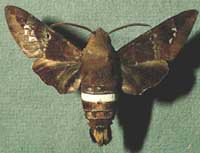 |
The body is dark brown with a wide white
band across the abdomen. Wings are dark brown. The forewing has a
black cell spot and 3 white spots near the pale brown marginal
area. stray |
 |
The body is dark brown with a wide white stripe across the abdomen.
The wings are dark brown. It is very similar to above species, but the
upperside of the hindwing has
pale patches along the costa and inner margin. stray
|
 |
This species is redder than C. parce, has more falcate wings and flies after midnight. The very similar
Callionima parce is browner, slightly less falcate and flies before midnight.
stray
|

|
The body and wings are dark brown. The forewing has a large black
patch covering most of the outer half of the wing. There is a pale
tan cell spot (dark inner pupil), and a fairly straight median line
to the inside of the cell spot. possible stray
|

|
The upperside of the forewing is dark brown with short yellowish
streaks on the forward half and wavy yellowish bands on the rear
half.
The upperside of the hindwing is bright yellow with a wide
dark brown border.
|
Erinnyis alope - 1 specimen, Jct. of FR 49 and FR 812, Patagonia Mountains, 7 Aug. 2010, elevation 5100', Evan Rand
 |
The upperside of the abdomen is gray, without black bands, and
the underside does not have black spots. The upperside of the
forewing is dark brown, and may have pale yellow-brown patches
along the inner edge.
|
 |
Erinnyis ello USGS/ER, the Ello Sphinx:
Abdomen has very distinct gray and black bands. Female's fw upperside is pale gray with a few dark dots near outer margin. Male's fw upperside is
dark gray and brown with a black band running from base to tip. Hindwing upperside is orange with wide black border.
|
Erinnyis ello
Evan Rand, (5), July 26-27, 2008, Pena Blanca Canyon
Evan Rand, July 30-31, 2008, Jct. FR 49 and FR 912, near Harshaw
 |
The upperside of the forewing is dark brown with gray streaks along the inner margin and a gray patch at the tip of the wing.
The upperside of the hindwing is dark brown with varying amounts of dark orange at the base.
stray
|
 |
During the night adults nectar at flowers, including bouncing bet
(Saponaria officinalis) and Asystasia gangetica beginning at dusk.
July and August are flight times in the southern states.
|
Erinnyis obscura - 2 males, California Gulch, Atascosa Mountains, 21 - July 2010, elevation 3800', Evan Rand
 |
Hemaris thetis WO, the Thetis Clearwing or Bee Hawk Moth,
The moth flies along forest edges and in meadows, gardens and
brushy fields. Day-flying adults nectar at lantana, dwarf bush honeysuckle,
snowberry, orange hawkweed, thistles, lilac, Canada violet, etc.
|
 |
Isognathus rimosa, the Rimosus Sphinx,
USGS/ER
The upperside of female forewing is mostly gray brown on the front
half and dark brown on the rear half while the upperside of male
forewing is yellow gray or gray brown. Both sexes have wavy dark
markings. The upperside of the hindwing of both sexes is yellow with
an incomplete dark border on the outer margin. stray
|
Isognathus rimosa
Evan rand, July 30-31, 2008, Jct. FR 49 and FR 912, near Harshaw
Philampelini tribe:
 |
The pink basal area of the hindwing clearly distinguishes this species.
Eumorpha achemon larvae feed upon Grape (Vitis),
Virginia Creeper (Parthenocissus quinquefolia)
and other vines and ivies (Ampelopsis).
|
Eumorpha achemon, Evan Rand, August 8, 2007, Pena Blanca
Eumorpha achemon, August 11, 2010, Pena Blanca, Eric Hossler
 |
Eumorpha fasciatus
USGS, the Banded Sphinx/Lesser Vine Sphinx
The upperside of the moth is dark pinkish brown. Each forewing has a
lighter brown band along the costa, and sharp pinkish white bands and
streaks. Larvae feed upon primrose-willow, Ludwigia (water primrose)
and other plants in the evening primrose family. stray
|
 |
The Satellite Sphinx Moth, Eumorpha
satellitia licaon flies in western Mexico and sometimes strays into southeastern
Arizona. stray
|
 |
Eumorpha typhon
USGS/ER/IN/HDK,
the Typhon Sphinx
The upperside of wings is deep red-brown with pale brown bands. Each
hindwing has pink along the costal margin and a triangular white spot
on the outer part of the inner margin.
|
Eumorpha typhon, Evan Rand, August 8, 2007, Pena Blanca
Ira Nadborne, (2) July 13, 2007, Coronado National Forest, Madera Canyon Upper Parking lot,
Santa Rita Mts, 6000Ft
Harry D. King, July 26, 2004
Eumorpha typhon, August 11, 2010, Pena Blanca, Eric Hossler
 |
The upperside of the moth is dark pinkish brown. Each forewing has a
lighter brown band along the costa, and sharp pinkish white bands and
streaks. The hindwing has a pink patch on the inner margin.
stray
|
Macroglossini tribe:
 |
Hyles lineata
USGS/RJN/ER,
the White-lined Sphinx The white lines on the body and forewings are striking.
Even in flight, the broad pink area on the hindwings is visible.
Larvae can be quite varied.
|
Hyles lineata
Robert J. Nuelle, Jr., August 6, 2004, Pena Blanca;
Evan Rand, Very common Santa Cruz Cos. (March to October)
Evan Rand, August 8, 2007, Pena Blanca
Evan Rand, (many) July 26-27, 2008, Pena Blanca Canyon
Evan Rand, July 30-31, 2008, Jct. FR 49 and FR 912, near Harshaw
 |
The upperside of the forewing is uniform olive green with a darker
median band. The upperside of the hindwing
is red with an olive green border.
|
Proserpinus terlooii, Evan Rand, mid July, 2007, Pena Blanca; (1) July 26-27, 2008, Pena Blanca Canyon
Proserpinus terlooii - 1 male, California Gulch, Atascosa Mountains, 21 July 2010, elevation 3800', Evan Rand
 |
Jim Tuttle writes, "P. vega has a very large and dark basal
patch as the FW meets the thorax that is lacking in terlooii.
There are also three prominent longitudinal
stripes on the thorax of vega that are lacking in
terlooii." possibility
|
 |
The upperside of the forewing is yellowish brown with dark brown markings in the basal area, and diagonally from near
the apex to the center of the inner margin. There is a small dark cell spot. The outer margin is distinct, set off
from the rest of the wing by a pale subterminal line.
unlikely stray
|

|
The upperside of the forewing is orange-brown along the forward half, striped with dark brown and light brown along
the rear half, with dark brown bands separating the two. The
upperside of the hindwing is pale brown with dark brown
marginal and submarginal lines.
|
Xylophanes falco
Evan Rand, uncommon in Santa Cruz Co. (late July/early August)
(40) Coronado National Forest, Madera Canyon Upper Parking lot,
Santa Rita Mts, 6000Ft,
July 13, 2007, Ira Nadborne
 |
The upperside of the forewing is pale brown with lavender-gray at the base and has dark brown lengthwise lines throughout.
The upperside of the hindwing is dark brown with a band of whitish, wedge-shaped marks.
stray
|
|
|