Sphinginae subfamily
Sphingini tribe:
 |
This species is a strong migrant and adults nectar from
deep-throated flowers including moonflower (Calonyction aculeatum),
morning glory (Convolvulus), honey suckle (Lonicera)
and petunia (Petunia species). rare stray
|
 |
Ceratomia amyntor
WO,
the Elm Sphinx or Four-horned Sphinx
The upperside of the forewing is brown with dark brown and white markings including a white costal area near the wing base, dark streaks along the veins,
and a white spot in the cell.
Larvae feed on Elm (Ulmus), birch (Betula), basswood (Tilia), and
cherry (Prunus).
|
 |
The upperside of the forewing is yellowish brown with no white markings, but there are indistinct black lines and dashes. The cell spot is gray with a black outline. The larvae feed in large groups and are much more
spectacular than the moths.
Catalpa is the larval host.
generally more eastern species |
 |
Ceratomia hageni
WO,
Hagen's Sphinx or Osage Orange Sphinx
The upperside of the forewing is gray with a green tint and has dark
indistinct wavy lines, and pale gray patches at the wing tip and
along the costa. generally more eastern species |
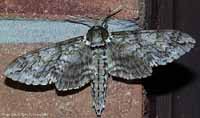 |
The upperside of the forewing is pale brownish gray with wavy black
and white lines and a black-outlined white cell spot. The upperside
of the hindwing is gray with diffuse darker bands.
|
 |
The upperside of the forewing is pale gray with a yellowish tint,
wavy black lines and dashes, and inconspicuous white spots.
|
 |
I suspect if you grow tomatoes, you are likely to encounter Manduca quinquemaculata.
|
Manduca quinquemaculata, June 12, 2006, Bill Genereux
 |
If you grow tomatoes, you have probably encountered Manduca sexta
in the larval stage.
Larvae get very large and can strip a tomato plant.
|
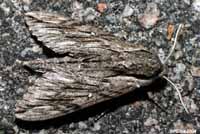 | The upperside of the forewing is gray with indistinct black and
white markings. There is a series of black dashes
from the base to the tip, and a small white cell spot.
|
 |
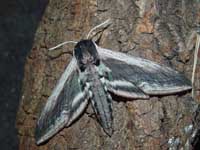
Sphinx chersis
WO, the Northern Ash Sphinx or Great Ash
Sphinx
This species is probably present in Cloud County.
Larval hosts are ash, lilac, privet, cherry, and quaking aspen.
|
 |
This species is not officially recorded, but I suspect it is
present. We have them on P.E.I., but I do not see them nearly as frequently
as I see the other Sphingidae.
|
 |
Sphinx vashti
USGS, the Snowberry Sphinx
The upperside of the forewing has a narrow black subterminal line
bordered by a white inverted V-shaped line on the outside, and a
black line running inwards from the apex of the wing.
It is most often found in montane woodlands and along streamcourses.
|
Smerinthini Tribe:
 |
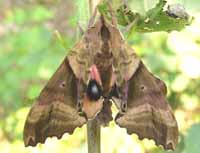
The adults are also highly variable; sometimes wings of an individual
may be all one color or may have several colors, ranging from pale to
dark brown, and may have a white or pink tinge. Patterns range from
faint to pronounced.
See the file for the female; she is different.
|
 |
Pachysphinx modesta
WO very questionable,
the Modest Sphinx or Poplar Sphinx
They are common on Prince Edward Island, but are not often reported
in kansas.
|
 |
Named for the dull grey-blue spot (minus dark pupil) in the hindwing,
this moth has a wide distribution in the eastern United States.
I regularly see them on Prince Edward Island, and they are reported
as far south as Florida. generally more eastern species |
 |
This small species is probably widespread and common. This species ranges across North America.
The hindwings have a small blue eyespot ringed with black on a yellow background.
|
 |
This moth is widely distributed and fairly common
in much of its range.
Along the East Coast, it flies from P.E.I. to Florida. |
Macroglossinae subfamily
Dilophonotini tribe:
 |
Erinnyis obscura, the Obscure Sphinx,
WO questionable
During the night adults nectar at flowers, including bouncing bet
(Saponaria officinalis) and Asystasia gangetica beginning at dusk.
July and August are flight times in the southern states.
rare
|
 |
Hemaris diffinis
WO, the
Snowberry Clearwing or Bumblebee Moth
Adults mimic bumblebees and are quite variable. The wings are basically clear, with dark brown to
brownish-orange veins, bases and edges. The thorax is golden-brown to
dark greenish-brown. The abdomen tends to be dark (black) with 1-2
yellow segments before the tip.
|
 |
Hemaris thysbe
WO, the Hummingbird Clearwing
It is not difficult to see why many gardeners would mistake an
Hemaris thysbe moth for a small hummingbird as it hovers,
sipping nectar from flowers through a long feeding tube. questionable, edge of range
|
Philampelini tribe:
 |
Larvae get large and feed on grape vines and Virginia creeper.
Note the differences between this moth and the Pandorus Sphinx.
|
 |
If you have Grape or Virginia Creeper nearby, then you probably have
this species.
I often get asked to identify larvae from areas not
previously reported.
|
Macroglossini tribe:
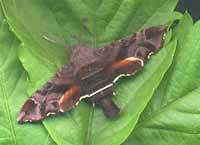 |
This day flier is widely distributed. If you have Virginia Creeper, you
probably have the Nessus Sphinx. Two bright, distinct, narrow yellow
bands are often visible on the abdomen.
|
 |
Darapsa myron WO, the Virginia Creeper Sphinx or the Grapevine Sphinx
If you have the
foodplants indicated in the common names, you probably have this
species nearby. The lower wings are orange.
|
 |
The moth's outer margin of the forewing is deeply scalloped.
The upperside is light brown with dark brown markings.
There is a small black and white spot near the tip.
Grape (Vitis), ampelopsis (Ampelopsis), and Virginia creeper
(Parthenocissus) all serve as larval hosts. questionable, edge of range
|
 |
Hyles lineata
WO, the White-lined Sphinx
This species has
strong migrating tendancies from much further south.
There are records from New Hampshire and Maine. |
 |
The upperside of the forewing is pale gray-green with a deep
green-brown median area and a white dash at the wing tip.
|
 |
This moth is very much under reported across the United States. It
is a rapid day flier so is probably not in too many collections.
Grape is a popular larval host. questionable, generally more eastern species
|
|
|