Lapara bombycoides, the Northern Pine Sphinx
Lapara bombycoides
luh-PAHR-uhmm
bom-bih-KOY-dees
Northern Pine Sphinx
Walker, 1856

Lapara bombycoides courtesy of Natural Resources, Canada.
This site has been created by
Bill Oehlke at oehlkew@islandtelecom.com
Comments, suggestions and/or additional information are welcomed by Bill.
TAXONOMY:
Family: Sphingidae Latreille, [1802]
Subfamily: Sphinginae Latreille [1802]
Tribe: Sphingini Latreille, [1802]
Genus: Lapara Walker, 1856
Species: bombycoides (Walker, 1856)
|
MIDI MUSIC
It's a Wonderful World
copyright C. Odenkirk
ON.OFF
<bgsound src="world.mid" LOOP=FOREVER>
|

Lapara bombycoides, July 3, Peterborough, Ontario, courtesy of Tim Dyson.
DISTRIBUTION:Lapara bombycoides, the Northern Pine Sphinx
(Wing span: 1 3/4 - 2 3/8 inches (4.5 - 6 cm)), ranges through mixed and coniferous forest in southern portions
of Canadian provinces from Manitoba, Ontario,
Quebec,
New Brunswick,
Nova Scotia and Prince Edward Island. It is also found in northeastern
Alberta and central Saskatchewan.
In the eastern half of the U.S. it can be found in extreme northeastern North Dakota, most of
Minnesota, Wisconsin,
Michigan,
Pennsylvania, New York
northward through Connecticut, Massachusetts,
Rhode Island, Vermont,
New Hampshire and Maine and southward in the Appalachian range from New Jersey
to western North Carolina.
The upperside of the forewing is gray with heavy black bands. The upperside of the hindwing is brownish gray with no
markings. The underside is rather plain as per this image, courtesy of
Tim Dyson, Peterborough, Ontario, July 6, 2005. | 
|
Visit Lapara bombycoides, Thorton, Grafton County, New Hampshire, courtesy of Deb Lievens.
Visit Lapara bombycoides adult moth, Florence, Hampshire County, Massachusetts, June 5, 2010;
Athol, Worcester County, Massachusetts, June 18, 2011,
courtesy of Betsy Higgins.
FLIGHT TIMES:
Male and female Lapara bombycoides moths come readily to lights from mid
June to mid July in Canada.
ECLOSION:
Little is known about the eclosions of the earth pupators, but
many believe pupae wiggle toward the surface just prior to emergence.
SCENTING AND MATING
Female Lapara bombycoides extend a scent gland from the posterior of
the abdomen to lure in the night flying males.
Livestock of the Northern Pine Sphinx is
usually available in the fall.
EGGS, LARVAE, PUPAE:
Lapara bombycoides eggs are a translucent pale green and
incubation lasts 8-10 days at constant temp of 68-72 F.
Larvae are without the anal horn (even in the first instar) typical
of most members of this family. Images to right and below, courtesy
of Tim Dyson.
|  |

| Larvae feed upon various pine species, including red
pine (Pinus resinosa), pitch pine (P. rigida), and
Scotch pine (P. sylvestris); and American larch
(Larix laricina). The white longitudinal stripes of this
third instar larva break the body into slender green "needles".
|

| Larvae progress very rapidly in later instars and are
very attractive and somehow remind me of Graellsia isabellae,
a Saturnid pine feeder from Spain. The red down the center of the
back (fourth instar) also blends in with the pine bark and the
sheath at the base of the needle.
|

| The red down the center of the
back (fifth instar) is more extensive and suggests the
needles which have dried with summer heat.
The white lines have yellowed.
Ian Miller from Eau Claire County, Wisconsin, reports,
"When disturbed the larva pulls its real legs into its body and tries to look like a twig or piece of bark."
|
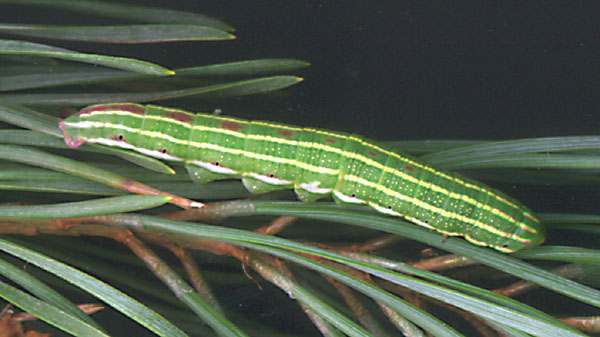
Lapara bombycoides fifth
instar larva by Bill Oehlke.

Lapara bombycoides fifth instar, Washington County, Rhode Island,
on Pinus strobus, September 12, 2010, courtesy of Ryan St. Laurent.
Look for greenish true (thoracic) legs on mature Lapara bombycoides. Those of Lapara coniferarum are orangey.
Larvae pupate readily under and/or between paper towels (no soil medium needed) in a
dark bucket.
Mixtures of soil, sand, peat and leaf litter can also
be used as pupation mediums. Under natural conditions pupation occurs in a shallow subterranean chamber reinforced with silk.
Pupae darken considerably as the shell hardens.

Lapara bombycoides pupae, courtesy of Tim Dyson.
Return to Sphingini Tribe
Return to Sphingidae Index
Enjoy some of nature's wonderments, giant silk moth cocoons.
These cocoons are for sale winter and fall. Beautiful Saturniidae moths will emerge the following spring and summer.
Read Actias luna rearing article. Additional online help available.
Use your browser "Back" button to return to the previous page.
This page is brought to you by
Bill Oehlke and the
WLSS. Pages are on space rented from Bizland. If you would like
to become a "Patron of the Sphingidae Site", contact Bill.
Please send sightings/images to Bill. I will do my best to respond to
requests for identification help.
 | 
Show appreciation for this site by clicking on flashing butterfly to the left.
The link will take you to a page with links to many insect sites. |