|
|
Updated as per http://www.pybio.org/MACROGLOSSINAE.htm (Paraguay), November 2007
Updated as per personal communication with Vladimir Izersky (Peru: Junin: Coviriali, 662m, February), December 2008
Updated as per The Known Sphingidae of Costa Rica, November 2007
Updated as per personal communication with Jose Monzon (Guatemala); May 2009
Updated as per personal communication with Andres oscar Contrares (Pilar, Neembucu, Paraguay); May 2009
Updated as per
AN ANNOTATED CHECKLIST OF THE SPHINGIDAE OF BOLIVIA, December 2009
Updated as per personal communication with Gregory Nielsen (Villavicencio, Meta, Colombia; February 24, 2011); March 24, 2011
Updated as per "A Hawk Moths fauna of southern Maranhão state, Brazil, ... "; NEVA: Jahrgang 34 Heft 3 November 2013; via Jean Haxaire; April 5, 2014
Updated as per personal communication with Sergio D. Ríos Díaz in CATÁLOGO DE LOS SPHINGIDAE (INSECTA: LEPIDOPTERA) DEPOSITADOS EN
EL MUSEO NACIONAL DE HISTORIA NATURAL DEL PARAGUAY; sent to me in July 2014 by Sergio D. Ríos Díaz.
|
Phryxus caicus
Phryxus caicus
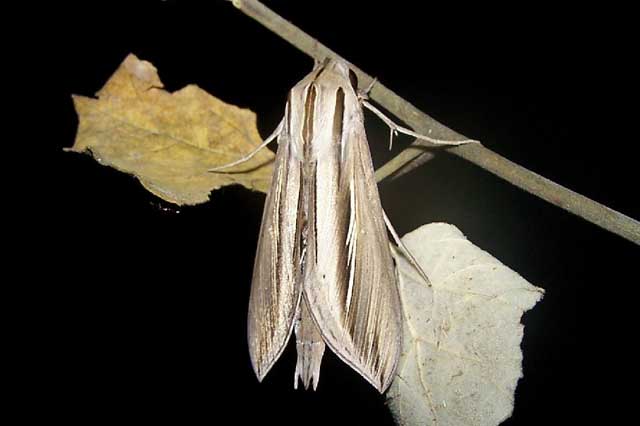
Phryxus caicus, Paraguay, PYBIO.
This site has been created by Bill Oehlke at oehlkew@islandtelecom.com
Comments, suggestions and/or additional information are welcomed by Bill.
TAXONOMY:
Family: Sphingidae, Latreille, 1802
Subfamily: Macroglossinae, Harris, 1839
Tribe: Dilophonotini, Burmeister, 1878
Genus: Phryxus Hubner, 1819 ...........
Species: caicus Cramer, 1777
|
MIDI MUSIC
.....It's a Wonderful World.....
copyright C. Odenkirk
ON.OFF
<bgsound src="world.mid" LOOP=FOREVER>
|
DISTRIBUTION:
The Caicus sphinx, Phryxus caicus
(wingspan: 2 3/4 - 3 1/4 inches (7 - 8.3 cm)),
flies from southern
Brazil: southern Maranhao;
Paraguay: Asuncion, Misiones, Boqueron, Presidente Hayes,
San Pedro, Canindeyu, Alto Parana, Central, Cordillera, Paraguari,
Guaira, and probably Caaguazu and Neembucu (AOC);
Bolivia: Beni, Santa Cruz (350-1700m);
and
northeastern Argentina: Misiones; through
Central America and north to Arizona and southern
Florida. Surinam is the specimen type locality. It is also recorded
in
Venezuela; and
Colombia: Meta: Villavicencio;
and it probably flies throughout Central America.
| 
|
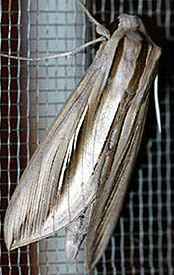
The abdomen of the Caicus sphinx has distinct black and tan bands.
The upperside of the forewing is brown with a tan band along the
inner margin and a thin tan streak in the middle of the wing. The
upperside of the hindwing is red-orange with short black bands along
the veins at the outer margin. Phryxus caicus (above-right), December 23,
2005, Misiones Province, near
Puerto Iguazu, near light at night, courtesy of Oz Rittner.
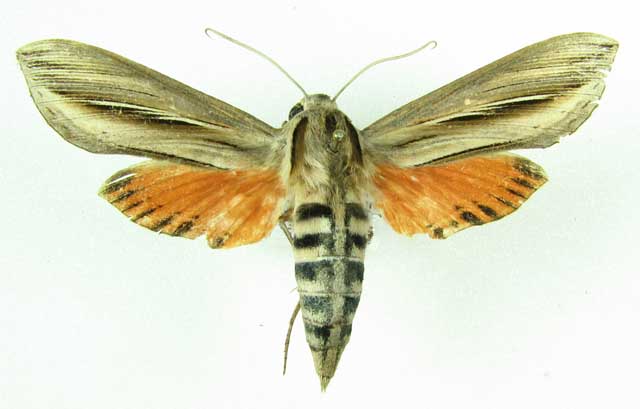
Phryxus caicus, Villavicencio, Meta, Colombia,
Km 13 via Acacias, 04°03’55.0 N 073°41’87.0 W
66mm, LFW=31mm, February 24, 2011, 500m, courtesy of Gregory Nielsen.
FLIGHT TIMES:
There are at least two flights in Florida, from January-March and July-September. In
Costa Rica moths have been taken in April, June-July and September
through January. Gregory Nielsen reports a February flight in Meta, Colombia. In northeastern Argentina there is at least one flight in December.
Sergio Rios Diaz confirms flights in Paraguay in January-February-March and May.
ECLOSION:
Moths eclose from pupae in fine silk cocoons spun up amongst leaf litter.
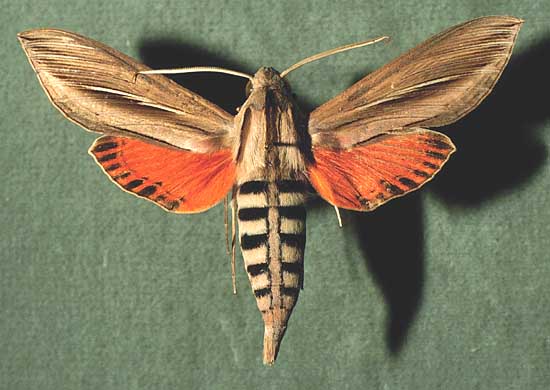
Phryxus caicus male courtesy of Dan Janzen.
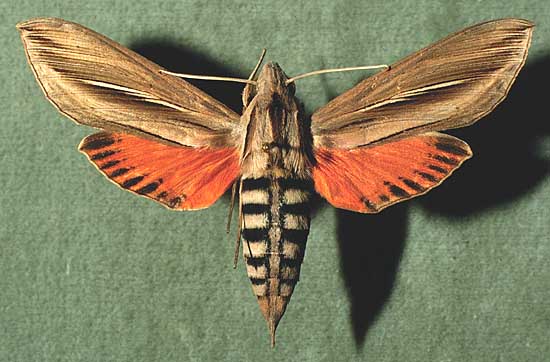
Phryxus caicus female courtesy of Dan Janzen.
SCENTING AND MATING:
Females call in the males with a
pheromone released from a gland at the tip of the
abdomen. Adults nectar at flowers, including Asystasia gangetica at dusk.
EGGS, LARVAE, PUPAE:
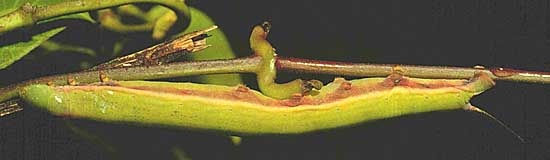
Larvae feed on
Mesechites trifida and probably on other members of the
Apocynaceae (Dogbane family: Echites). In Florida larvae
have been reported on mangrove rubber vine
(Rhabdadenia biflora). Carica papaya serves as a larval host in Brazil.
Moths emerge in as few as fourteen days after pupation from a
cocoon of very fine silk spun among leaf litter.

Return to U. S. A. Table
Return to Sphingidae Index
Return to Dilophonotini Tribe
Use your browser "Back" button to return to the previous page.
This page is brought to you by
Bill Oehlke and the
WLSS. Pages are on space rented from Bizland. If you would like
to become a "Patron of the Sphingidae Site", contact Bill.
Please send sightings/images to Bill. I will do my best to respond to
requests for identification help.
Enjoy one of nature's wonderments: Live
Saturniidae (Giant Silkmoth) cocoons.
 | 
Show appreciation for this site by clicking on flashing butterfly to the left.
The link will take you to a page with links to many insect sites. |