Pachysphinx modesta, the Modest Sphinx
Pachysphinx modesta
PACK-kih-sfinksmmmuh-DES-tuh
(Harris, 1839)
Smerinthus

Pachysphinx modesta, Peterborough, Ontario, June 11, 2005,
courtesy of Tim Dyson.
This site has been created by
Bill Oehlke at oehlkew@islandtelecom.com
Comments, suggestions and/or additional information are welcomed by Bill.
TAXONOMY:
Family: Sphingidae, Latreille, 1802
Subfamily: Sphinginae, Latreille, 1802
Tribe: Smerinthini, Grote & Robinson, 1865
Genus: Pachysphinx Rothschild and Jordan, 1903
Species: modesta (Harris, 1839)
|
MIDI MUSIC
It's a Wonderful World
copyright C. Odenkirk
ON.OFF
<bgsound src="world.mid" LOOP=FOREVER>
|
DISTRIBUTION:Pachysphinx modesta, the Poplar Sphinx or
Modest Sphinx ranges through southern portions of all Canadian
provinces and is found in the eastern half of the U.S. from Maine to
northern Florida. James P. Tuttle has range maps showing it as far west as eastern Washington southward to
extreme northeastern New Mexico. Most of the western specimens appear to be P. occidentalis, and I would not be surprised
if there is some natural hybridization in the western states.
FLIGHT TIMES:Male and female Pachysphinx modesta moths come readily to lights from mid
June to mid July in Canada. In the northern part of its range it is single brooded with a flight from may to July. South of Missouri,
the moth might be double brooded.
|
 |
This moth has a large, heavy body, and females can be remarkably
plump. Tim Dyson recorded the moth depicted above on June 8-9 in Peterborough,
Ontario.
ECLOSION:Little is known about the eclosions of the earth pupators, but
many believe pupae wiggle toward the surface just prior to emergence.These pupae were
difficult to scan as they were very active. Pachysphinx modesta pupae are quite large compared
to those of other Sphingidae,
especially here on P.E.I. | 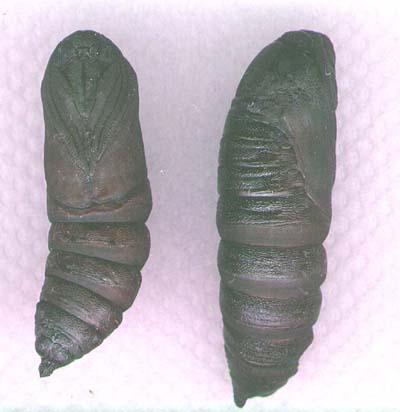 |
SCENTING AND MATINGFemale Pachysphinx modesta extend a
scent gland from the posterior of the abdomen to lure in the night
flying males whose large claspers are frequently wide open as
they fly in to lights around midnight.
Many thanks to Leslie Hubbard who encountered a freshly emerged female Pachysphinx modesta, June 5, 2015. Leslie got to watch the moth inflate its wings,
and then found it coupled with a male the following morning.
Leslie writes, "Was cleaning out my flower bed today June 5, 2015 about 4:00 pm. All of a sudden "this thing" appeared - it was unlike anything I had seen before.
Reminded me of a hellbender you see in streams. Within 4 hours it morphed into a big poplar sphinx. I have watched monarchs go through their life cycles but
this was a new one on me. Thought you might enjoy the pictures. Really didn't know much about moth life cycles until today - thanks for all your wonderful
information!"

Pachysphinx modesta female newly emerged, left (June 5); in copula right (June 6),
Litchfield, Kennebec County, Maine, courtesy of Leslie Hubbard.
The moth needs to climb and hang so that it can properly pump fluid into its wing veins so they can inflate and then harden in preparation for flight.

Pachysphinx modesta female hanging/inflating, left (June 5); inflated/resting (June 5),
Litchfield, Kennebec County, Maine, courtesy of Leslie Hubbard.
 |
Almost fully inflated, the wings are still quite soft. The inflating process usually takes 15-30 minutes, and then it is often an hour or two
after that that fluid has hardened and wings are stiff and ready for flight.
The female usually does not fly until she has copulated with a male. Shortly before midnight she extends a wick-like structure from abdominal tip
and exudes a pheromone (scent) into the night sky. Males fly into the wind and track the pheromone to locate the female.
|
Often the pair will remain in copula until the following evening. The male flies off in search of another mate and the female begins her egg laying flight, depositing
eggs in small batches (4-6) on host plant (poplars, willows) foliage. Over four to five nights she will visit many trees and deposit between 200-300 small green eggs.
Neither the male nor female will eat anything in the adult stage. They have no mouth parts or feeding tubes. It would seem their sole purpose is reproduction,
and they only usually live off fats stored from their caterpillar days for an adult life of 5-8 days.
Perhaps in 4-6 weeks Leslie will find a caterpillar or two feeding on a nearby poplar or willow. There is probably one in her yard near the garden!
Livestock of the Modest Sphinx is
usually available in the fall.
Tim Dyson, Peterborough, Ontario, and
I (Bill Oehlke, Montague, Prince Edward Island) have both noticed a
preponderance of males early in the flight season, followed by a
much greater number of females as the season progresses.
EGGS, LARVAE, PUPAE:
Pachysphinx modesta eggs are quite
large and a translucent pale green. As incubation (8-10 days)
progresses, the eggs turn a shiny bronze color.
Tim Dyson sent this image to "to show how they 'ripen like grapes'
prior to hatching." Moths oviposit readily in brown paper bags.
|
 |
Warmth hastens the development of the eggs which
hatch 8-12 days after deposition.
Larvae have a characteristic pattern and
colouration even as hatchlings, as is evident in these images of
a day old larvae, courtesy of Tim Dyson. They also rest in typical Sphingidae pose.
| 
|

These hornworms feed
upon poplar, willow, and cottonwood, are very strong and develop to quite a size.
Larvae progress very rapidly on poplar. The green of the early hornworm instars is
very much like the top of the poplar leaf while the pale green of the final instar
more closely resembles the color of the underside of poplar leaves.
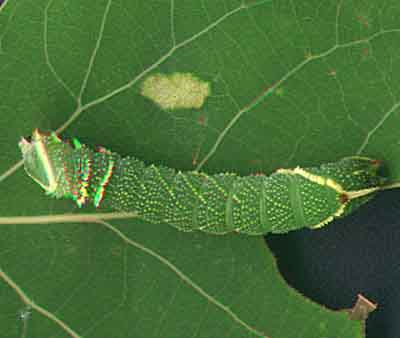
Larvae are extremely strong with powerful mandibles. Here a third instar hornworm larva has
dark green coloration with yellow body lines. Scan by Bill Oehlke. |
 |
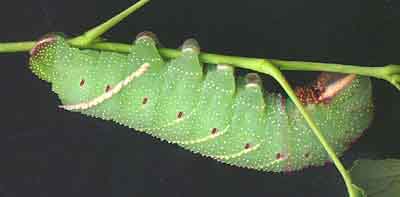
Just prior to pupation
larvae take on a light purplish hue, descend the tree and will chew right through
my Remay sleeves if I don't remove them. This species pupates readily under
artificial conditions, and pupae are large (50mm long), dull, dark, and rough.
Some larvae (Ian Miller) have considerably more red spotting. The anal horn
is greatly reduced in the final instar.
|  |

Pachysphinx modesta prepupal larva, Cantigny, Wheatley, Henry County, Illinois,
August 8, 2010, courtesy of Rita Dakin.

Pachysphinx modesta prepupal, Vegreville, Alberta, August 24, 2008, courtesy of David Hibbeln.
Shannon Larsen sent me the beautiful images below of
a male (note arched abdomen) Pachysphinx modesta, taken
August 21st, 2004, in Centerview, Missouri.

Females have a "turkey baster" shaped abdomen that hangs straight
down when the moth is at rest.
One does not often get to see the underside of this moth as a live specimen,
but Tim Dyson provides a "quick shot" (below) of a female (top) making a landing.
The underside of the hindwing is not nearly as vibrant as the dorsal surface.


Visit Pachysphinx modesta, MV light on small building on County Hwy R18, Boone County, Iowa,
June 23, 2009, Thomas Jantscher
Visit Pachysphinx modesta fifth instar on cottonwood, Houston, Harris County, Texas, June 20, 2011,
courtesy of Cory Melancon.
Visit Pachysphinx modesta, Peterborough, Ontario, June 28, 2012, Paula Sheppard
Visit Pachysphinx modesta female, at light at Xavier High School, July 19, 2011, Tom Jantcher
Visit Pachysphinx modesta female and larvae, British Columbia, Canada, Ben Trott
Foodplants:
| Poplar
Large-toothed/Bigtooth Aspen
Willow
|
Return to U. S. A. Table
Return to Main Sphingidae Index
Return to Smerinthini Tribe
Enjoy some of nature's wonderments, giant silk moth cocoons.
These cocoons are for sale winter and fall. Beautiful Saturniidae moths will emerge the following spring and summer.
Read Actias luna rearing article. Additional online help available.
Use your browser "Back" button to return to the previous page.
This page is brought to you by Bill Oehlke and the
WLSS. Pages are on space rented from Bizland. If you would like to become a "Patron of the Sphingidae Site", contact Bill.
Please send sightings/images to Bill. I will do my best to respond to requests for identification help.
 | 
Show appreciation for this site by clicking on flashing butterfly to the left.
The link will take you to a page with links to many insect sites. |