LIVESTOCK AND SUPPLIES
All materials listed can be ordered via email to Bill Oehlke at
oehlkew@islandtelecom.com
or via regular mail:
Bill Oehlke
P.O. Box 476
155 Peardon Road
Montague, PE, C0A 1R0
Canada
I ship to both Canadian and United States destinations.
I live on Prince Edward Island in eastern Canada and usually rear the following six indigenous Saturniidae species during the summer, and I offer livestock of same
from September (best month to order) into early winter: Actias luna, Anisota virginiensis, Antheraea polyphemus, Dryocampa rubicunda, Hyalophora cecropia, Hyalophora columbia.
In Canada, as of January 8, 2015, I am currently sold out except for a small number of Actias luna cocoons and a small number of Pachysphinx modesta pupae.
Some years I rear additional local Sphingidae species, and occasionally I rear some Canadian Tiger Swallowtails (Pterourus canadensis and offer the pupae for
sale. Shipping costs within Canada vary, based on the size of your order and your actual destination.
I also work with a number of experienced breeders in the United States who rear livestock for me. I or one of my US shipping partners ships
livestock from within the US to US destinations in the fall or winter. As of January 8, 2015, for US distribution, I am currently sold out except for
Actias luna, Antheraea polyphemus, Callosamia promethea, and Hyalophora cecropia. I also still have a very small number of Eastern Tiger
Swallowtail (Pterourus glaucus) pupae. Shipping and handling to US destinations is a flat fee of $9.00 whether you order one item or twenty items, etc.
If you wish to purchase livestock, please send all of the following information in your initial email enquiry:
1) Complete shipping address
2) Species and quantities desired
3) Desired payment method: personal check, cashier's check, Paypal.
Always confirm availability of stock, preferably by email, before sending payment. Livestock only is available. Dead specimens are not sold; referrals are not
provided. I deal exclusively with North American species.
Order early before supplies are depleted. The best time to order is usually early October for US customers. All USA cocoon/chrysalid/pupae orders must include
one $9.00 (2015 rate for shipping within US) postage and handling fee for the entire order. In Canada the postage amount willl vary depending upon the size of the
order and your actual address. I cannot give you a price quote without that information.
Personal checks are preferred method of payment, but I can also except cashier's checks drawn on a US bank, international money orders in US funds,
or payment by Paypal. I am not set up to handle any payments by credit cards.
There is a discount of approximately 10% on most items (cocoons, chrysalids and pupae) for all members
of the WORLD'S LARGEST SATURNIIDAE SITE club. Details at
http://www.silkmoths.bizland.com/indexos.htm Members' prices are printed in red.
SATURNIIDAE: SILKMOTHS
The following species are usually available in the fall, but many species quickly sell out.
|
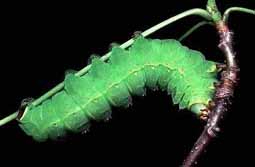 |
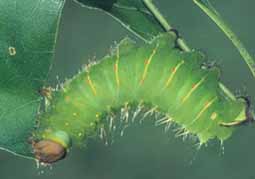
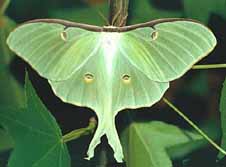
Actias luna one of
the most trouble free silkmoths to rear.
Strongly recommended for
beginners.
Does well indoors or out. $4.60/cocoon
still available
|  |
 |
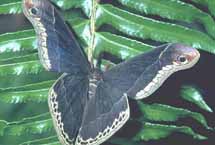
Callosamia promethea cocoons hang from trees throughout the winter and are easy to find.
Females: brown; males: black. $4.75/cocoon
still available
|  |
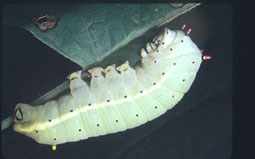 |
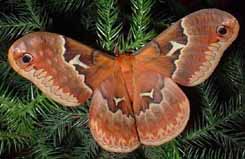
Callosamia angulifera: Tulip Tree Moth. Caterpillars feed on Liriodendron tulipifera (Tulip tree)
$6.75 not available in 2014-2015
|  |
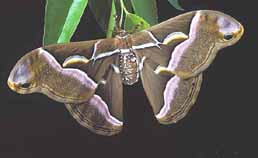
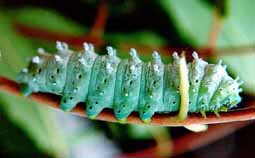 | Samia cynthia was
introduced into U.S. in late 1800's to establish a silk
industry. Populations are in Connecticut, New York, New Jersey.
$5.50 sold out
|  |
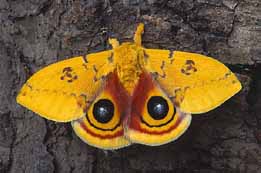
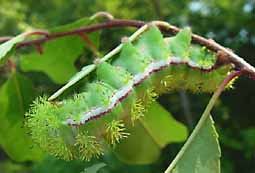 | Ouch!
Automeris io
larvae feed in groups, can give nasty sting.
Females: reddish-brown forewings; males: yellow.
$5.50 sold out
|  |
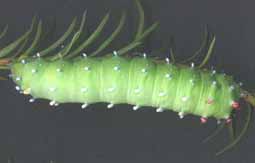 |
Hyalophora columbia
closely resemble cecropia. Larvae: three sets of red tubercles;
willow; cherry; prefer juniper/tamarack/larch. $6.75
SOLD OUT!
|  |
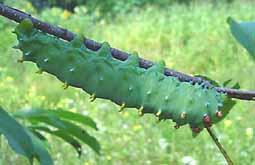 |
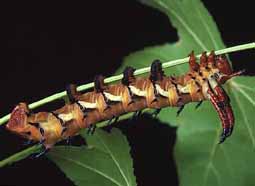
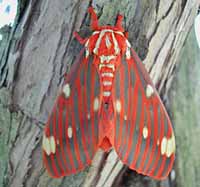
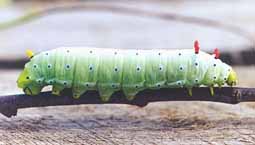
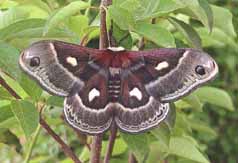
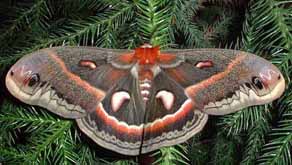
Hyalo. cecropia
one of North America's largest silkmoths.
Larvae get humongous! $6.25
still available
|  |
SPHINGIDAE: HAWKMOTHS
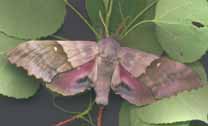
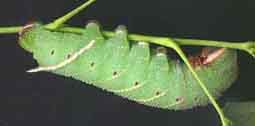 | Pachysphinx modesta,
the Modest Sphinx or Poplar Sphinx, has a heavy body. Larvae are chunky and
not as elongated as some of the other Sphingids. $4.00 Canada only
still available
|  |
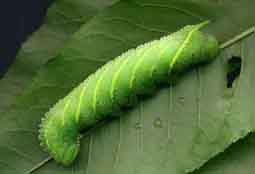 | Paonias excaecata,
The Blinded Sphinx, has striking underwings and takes its name from
the blurred, blue-gray "iris" in the under wing.
not available 2014-15
|  |
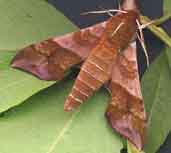
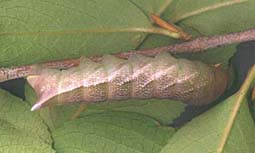 | Darapsa choerilus
(was pholus), The Azalea Sphinx, has striking orange underwings.
Green larvae darken just before pupation.
Pupae are very active.
$3.00 not available 2014-2015
|  |
PAPILIONIIDAE: BUTTERFLIES
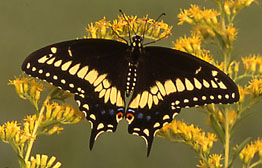
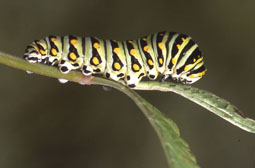 | Black
Swallowtail, Papilio polyxenes asterius, larvae are often found in
the garden on carrots, parsley, celery and related plants.
SOLD OUT
|  |
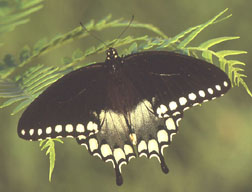
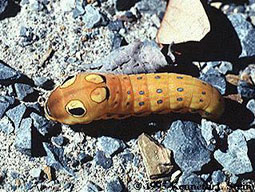 | Spicebush Swallowtail females
have powdery blue scales on lower wings; males are adorned wth green scales. Larvae hide by day in a leaf furl.
SOLD OUT
|  |
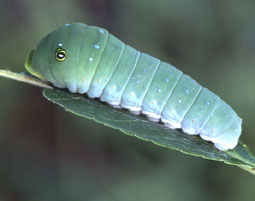 |
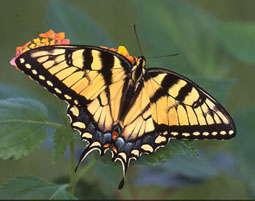
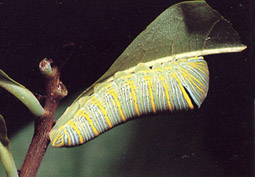
Tiger Swallowtails like to drink at mud puddles and
along river banks as well as nectar at flowers.
$4.90
still available
|  |
 |
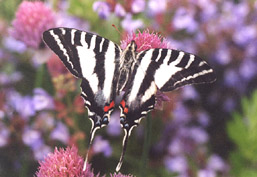
Zebra Swallowtails real beauties with strongly contrasting pale
yellow (almost white) forewings with black stripes.
Pawpaw feeders. $6.00
not available 2014-15
|  |
I also sell Saturniidae eggs in the spring and summer and will soon post a link to an egg price list from this page.
Prior to beginning of 2015, I had a public website on webspace provided by my phone company for the pleasure of making my phone calls and operating an email
account with them. The webspace they were providing is no longer available so I am in the process of moving all files to a new location. It may be a while before
I get everything up and running again.
Return to Main Index
|